From Software Engineering to AI–Driven Robotics: Yogesh’s SustAInLivWork Experience in Finland
Before beginning his Master’s studies in Artificial Intelligence at Kaunas University of Technology, Yogesh Kumar Srinivasan was working as a Senior Java Programmer in Chennai, India. Today, his academic and research interests extend to reinforcement learning, robotics and language–driven robot interaction – a direction further strengthened by his SustAInLivWork internship at Tampere University.
During November–December, Yogesh completed a winter semester internship at Hervanta Campus under the supervision of Professor Roel Pieters. Together with his course mate, he joined a research group exploring how Large Language Models (LLMs) can support robot programming and control.
From Industry Automation to Artificial Intelligence
Before coming to Lithuania, Yogesh worked on large–scale software migration tools, helping transform legacy systems such as COBOL and JCL into modern Java Spring Boot and Angular codebases.
“Being involved in large–scale automation of software transformation made me think deeply about how intelligent systems powered by AI could further improve and automate such complex processes,” he explains.
Alongside this practical experience, he had long been curious about machine learning and cognition: “I have always been curious about how machines can learn – what’s the magic behind it, and when a machine attains a cognitive thinking ability to interact with the real world.”
That combination of professional exposure and intellectual curiosity ultimately led him to pursue advanced studies in AI.

Expanding Research Horizons
Yogesh completed his Bachelor’s degree in Computer Science Engineering at Meenakshi College of Engineering, affiliated with Anna University in Chennai. His undergraduate studies provided a strong foundation in programming, algorithms and mathematics – skills that supported his transition into advanced AI topics.
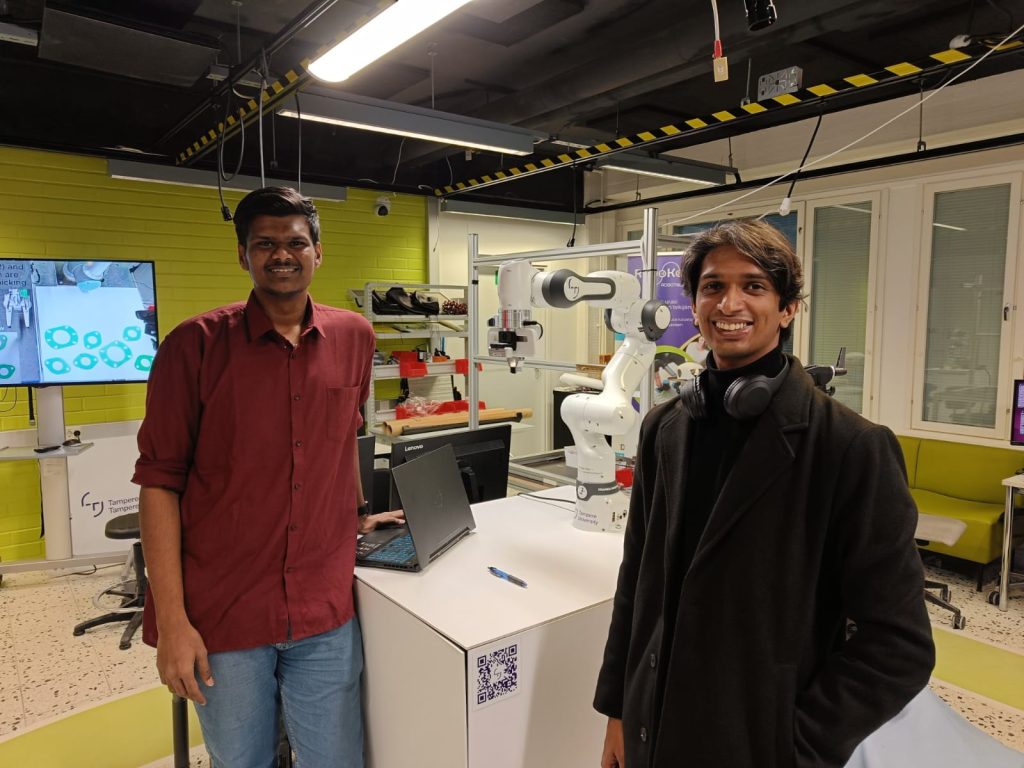
Currently, his research interests include training AI systems to make decisions, understanding how and why those systems make choices, and applying AI to robotics.
His Master’s thesis looks at how well decision–making AI can perform when the calculations become very demanding. In practice, he studies a logistics–style problem where an AI system needs to choose the best option under several rules and limitations.
“In simple terms, I am investigating the computational limits of these algorithms when selecting the most suitable containers from port storage yards based on specific customer booking conditions,” says Yogesh.
In parallel, he is also exploring how AI models can be made more efficient. He studies what happens when you reduce the “precision” of calculations in image–processing models – a common technique used to make systems faster and less resource–hungry, especially when computing power is limited. More recently, his attention has shifted towards robotics and language models.
“The idea that natural language or high–level instructions can be translated into executable robot actions is particularly exciting to me,” he says. “I am deeply interested in combining AI reasoning with physical robotic systems.”
Inside RoboLab Tampere
At Tampere University, Yogesh became actively involved in research on how Large Language Models can support robot programming and control. A key part of the internship was seeing how separate components – software, simulation and real hardware – come together into one working robotic system.
He worked with tools that help robots plan safe movements, and with simulation environments where those movements can be tested virtually before anything is run on a real robot. This allowed him to experiment and learn in a controlled way while understanding how software decisions translate into physical actions.
“The most interesting part of the experience was understanding how different robotics technologies integrate into a complete working system,” he says. “It helped me understand not only algorithms but also how software interacts with robotic hardware under practical constraints.”
Beyond his own work, Yogesh explored ongoing projects in the lab focused on human–robot collaboration and natural language interaction. For example, he examined a system designed to support visual inspection tasks where humans and robots work together, and he also experimented with a voice–based robot control approach powered by language models. These examples showed how language–driven reasoning can support robots in practical, real–world settings.
Technical Depth and Long–Term Impact
One of the most challenging parts of the internship was setting up a stable working environment for robotics experiments. This required making sure that different pieces of software and the simulator worked well together – which can be difficult when systems are updated frequently and are not always compatible by default.
Once the environment was set up properly, it became much easier to focus on experimentation. Yogesh could spend more time testing how language–model–based instructions could be connected to robot control pipelines and evaluating what works best.
Reflecting on the broader impact of the experience, Yogesh sees it as an important step towards his long–term goals.
“This experience has strengthened my interest in AI–driven robotics and intelligent automation,” he says. “Working in an international research environment improved my independence, problem–solving ability, and confidence in handling complex technical systems.”
The SustAInLivWork internship not only expanded his technical expertise but also deepened his engagement with research at the intersection of AI and robotics – a field he sees as central to the future of intelligent systems.